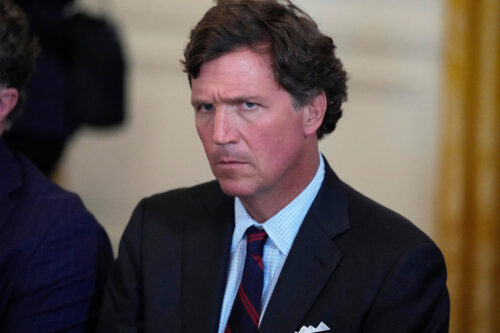
President Donald Trump made clear Tuesday that the fate of the Iranian people — and their civilization — is in his hands as he threatens to bomb them back to the “stone ages.”
But the Iranian regime has a trump card too: Continuing its blockade of the Strait of Hormuz, a global energy chokepoint so vital that decisions made today could determine the global economy for months, even years, to come. Oil and gas shortages as a result of Iran’s blockade have already caused a crisis in parts of Asia and Europe, tipping some countries such as Japan, South Korea and the United Kingdom dangerously close to recession.
Trump has set a deadline of 8 p.m. today for Iran to agree to reopen Hormuz or face a wave of destruction that will start with the power grid, energy infrastructure and desalination plants, which are crucial for providing potable water for millions of people. Iran has pledged to retaliate by obliterating energy infrastructure in the region, which provides about 20 percent of the world’s oil and gas, and effectively keeping Hormuz shut for the foreseeable future.
But both Trump and the Iranians appear — at least publicly — emboldened.
Whatever happens Tuesday evening, the path to reopen Hormuz remains murky at best and oil prices are already trading above $110. Average retail prices of gasoline in the U.S. reached $4.14, according to AAA – and are likely to go even higher absent a resolution.
A White House spokesperson pointed to Trump’s Monday press conference in response to questions, in which he said “We have to have a deal that’s acceptable to me and part of that deal is going to be we want free traffic of oil and everything else.”
Since Trump’s war against Iran began in late February, the president has promised several scenarios that he says could reopen the strait – many of them contradictory, and most of them difficult if not unlikely. Here are four ways Trump has said the Hormuz problem can be solved.
More bombing will force the Iranians to capitulate.
“Open the Fuckin’ Strait, you crazy bastards, or you’ll be living in Hell – JUST WATCH!” Trump wrote on Truth Social on April 5.
Trump has repeatedly threatened more intensive bombing but in the past week he’s ratcheted up his threats to include targeting sensitive civilian and energy infrastructure. The latest threat, a demand that Iran strike a deal by 8 p.m. Tuesday or face destruction, is the most dire iteration.
Both sides appeared dug in just hours ahead of the deadline, with even those close to Trump saying they weren’t sure what would happen.
Trump has publicly reasoned that continuing to bomb Iran will weaken the country so significantly that it won’t take long to reopen Hormuz. If its military is decimated, the regime won’t be able to attack shipping. (Though he has also acknowledged that Iran doesn’t need military might to close the strait, just an armed group on shore.)
But the Iranian regime is resilient, and that means Trump won’t be able to bomb his way into reopening Hormuz, said Ali Vaez, Iran project director at the International Crisis Group, a group that advocates for conflict resolution.
“There is no military solution to this challenge,” said Vaez, who has said he speaks with people on all sides of the negotiations. “The only path is a mutually beneficial diplomatic arrangement.”
But diplomacy seems far off. Trump has only reiterated his threats, and
Iran’s parliamentary speaker, Mohammad Bagher Ghalibaf, has made it clear that Hormuz is the primary lever of power for the Iranians, which they are using to drive up energy costs in order to deter the U.S. and Israel from further attacks.
“Your reckless moves are dragging the United States into a living HELL for every single family, and our whole region is going to burn because you insist on following [Israeli Prime Minister Benjamin] Netanyahu’s commands,” he wrote on X on Sunday. “Make no mistake: You won’t gain anything through war crimes.”
But whatever Iran is claiming publicly should not be taken as the reality faced by the regime inside the country, said Rich Goldberg, the former senior counselor for the Trump White House National Energy Dominance Council. He said the repeated bombing of regime strongholds and Iran Revolutionary Guard buildings and positions is weakening their grip on power.
“At some point economic stress and the toll it is taking is going to collapse their hold on power,” Goldberg said. “And so they probably are motivated to get to a deal.”
Countries more reliant on the strait should act to reopen it.
“Build up some delayed courage, go to the Strait, and just TAKE IT,” Trump wrote on Truth Social on April 1.
Trump has suggested that the U.S. is less reliant on Hormuz for its oil supply than Asia and Europe – and so countries in those regions should intervene to force Iran’s hand.
It is true that other parts of the world are nominally more reliant on the passage of supplies through the strait, but that discounts the reality that oil prices are set by the global market, which has already seen prices spike above $110. Prices at the pump in the U.S. have already topped an average of $4 nationwide and diesel is already above an average of $5.
There have been no public moves thus far from a coalition of willing countries capable of forcing Hormuz to reopen, however.
On Tuesday, China and Russia blocked a United Nations Security Council resolution designed to reopen Hormuz. It was a weaker version of an earlier resolution by Gulf Arab countries that would have authorized the use of force to open up the strait.
But Goldberg, the former Trump White House official, said that there is still a diplomatic path for the U.S. to step away from the conflict in exchange for an end to the bombing and Iran’s pledge not to impose tolls on the strait. He said that opens the door for countries in the region and in Asia to start ramping up tanker traffic rather quickly.
“The middle ground is where the Iranians are not running the strait,” said Goldberg, who is now a senior adviser at the Foundation for Defense of Democracies. “They’re not taking tolls, the U.S. is not providing a military escort, there’s no active threat on the water, no active threat in the air, and the tanker flow resumes by agreement.”
The strait will “naturally” reopen once conflict ends
“When this conflict is over, the strait will open up naturally,” Trump said in his nationally televised address on April 1.
This option appears to give Iran the full right to treat the strait as its own tollbooth. Already, Iran is letting the ships of some allies pass and others already appear to be paying tolls for access, Bloomberg has reported.
But letting Iran impose tolls on Hormuz would prompt “every chokepoint state on earth [to] study that precedent carefully,” Nawaf Bin Mubarak Al-Thani, president and founder of the Council on International Mediation and a former senior defense official in Qatar, wrote on X.
“The issue would no longer be one strait in one region,” he wrote. “It would become a template for coercive monetization of maritime passage across the world’s most sensitive trade arteries. That is not a regional adjustment. That is systemic destabilization.”
The U.S. and Iran reach a diplomatic agreement and partner on Hormuz operations
“Jointly controlled. Maybe me, maybe me. Me and the ayatollah, whoever the ayatollah is,” Trump told reporters on March 23.
This is perhaps the least likely scenario, in which the leader of the Iranian regime would partner with the country that just decapitated its leadership – especially absent any signs of interest on Iran’s part in such a thing.
On Monday, Trump suggested that the U.S. should start charging its own Hormuz tolls.
“What about us charging tolls?” he told reporters.
“I’d rather do that than let them have them. Why shouldn’t we? We’re the winner. We won.”
It’s unclear if that’s an idea the administration is taking seriously, but experts said it’s a non-starter for the Iranians.
The Iranians also want more than the end of the war, said Greg Priddy, an expert on energy market disruption who worked at the U.S. Energy Information Administration in the George W. Bush administration and is now a senior fellow at the conservative Center for the National Interest. They are asking for reparations and claiming they have a right to control Hormuz.
“If we stop bombing, they’re not necessarily going to let us off the hook,” Priddy said. “They have more demands than that.”

Europa Monitor is a seasoned News Editor with over a decade of experience in journalism. Known for his editorial expertise and commitment to accuracy, Europa Monitor leads teams to deliver high-quality news content.