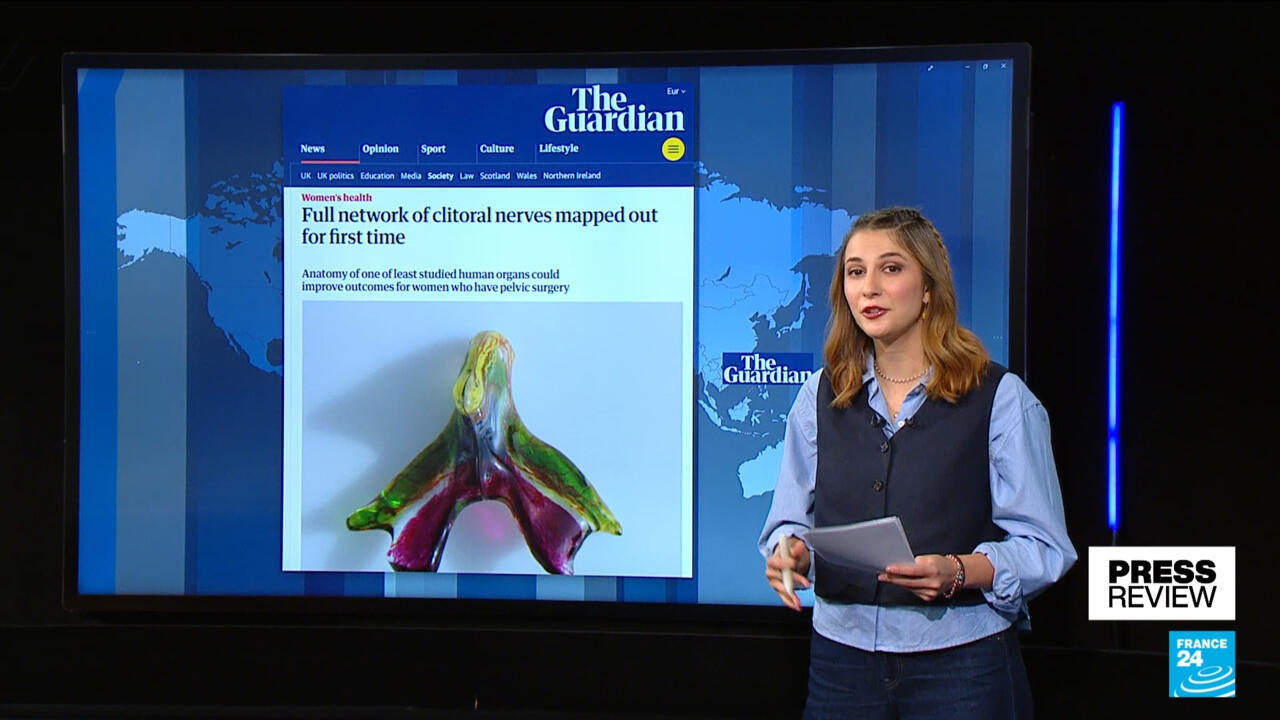
PRESS REVIEW – Monday, March 30: Papers discuss the use of artificial intelligence in war and the ethics behind it. Staying with AI, German actress Collien Fernandes says Germany is a haven for perpetrators, after she revealed her husband has been sharing deepfake porn of her. Next: a story about squatters living in Gangnam, the richest part of Seoul. Finally, scientists have mapped the nerves of the clitoris for the first time.
Papers are discussing the use of artificial intelligence in warfare. The title of French daily Libération‘s front page reads “AI, war in automatic mode”. It’s an analysis piece that says AI now plays a significant role in military operations, including in Gaza, Iran and Ukraine. It talks about the many different uses of AI, like US Defence Secretary Pete Hegseth’s “AI first” approach. What has changed with AI is that there’s no need for data analysts to analyse information collected by satellites or video anymore – it’s now AI’s work, so “in practical terms, AI accelerates the kill chain”.
Read moreStreamlining the kill chain: how AI is changing modern warfare
The article also talks about the cognitive gap between the person who launches the attack and the victim. A study by King’s College London says that AI models appear to make decisions that lead to escalation much faster – they threaten to use nuclear weapons in nearly 95 percent of the simulated scenarios. Le Monde interviewed a philosopher who specialises in military ethics. She believes that “the use of lethal autonomous weapons controlled by AI goes against the principles of a just war”. She says that in order to ensure the proportionality of the strike, data needs to be verified in advance by humans, in order to carry out what’s been dubbed “effective human oversight”.
In some shocking news, German actress Collien Fernandes revealed publicly last week that her ex-partner had been spreading deepfake pornography of her – a case dubbed “digital rape”. Der Spiegel reports that she said Germany is a haven for perpetrators and only 2.4 percent of digital violence is reported. She says that her own experience with law enforcement has been discouraging.
In other AI news, it turns out it’s not a good idea to ask AI bots for personal advice. Twelve percent of US teenagers turn to chatbots for emotional support advice – they ask for relationship advice and even draft breakup texts. The problem, however, is that AI usually validates user behaviour and doesn’t provide the “tough love” that’s sometimes needed. AI just convinces people they are right and makes them less likely to apologise.
Moving to South Korea, The New York Times reports about “the squatters living in the richest part of Seoul”: the Gangnam district. The feature article follows the story of Miss Lee. The government has offered more than $3,000 for her hut and told her to vacate or face eviction. But owning a home is a struggle and she has “nowhere else to go,” so she is fighting to stay. In Gangnam, which inspired the K-pop hit “Gangnam Style”, prices have been spiking faster and higher than anywhere else in Seoul.
Finally, there’s some good news for women around the world: The Guardian reports that scientists have finally mapped the nerves inside the clitoris. This comes almost 30 years after they did the same thing for the penis. This is beneficial and not only for orgasms – understanding this organ could help prevent poorer sexual function after pelvic operations. It could also help with reconstructive surgery after female genital mutilation – “one of the most extreme examples of cultural misogyny”. The Guardian writes that a cultural taboo around female sexuality has held back scientific investigations. The clitoris only entered standard medicine textbooks in the 20th century.
You can catch our press review every morning on France 24 at 7:20am and 9:20am (Paris time), from Monday to Friday.

Europa Monitor is a seasoned News Editor with over a decade of experience in journalism. Known for his editorial expertise and commitment to accuracy, Europa Monitor leads teams to deliver high-quality news content.