BRUSSELS — The war in Iran has reduced the world’s seven most advanced economies to the most rudimentary of policies: waiting.
Finance and energy ministers and central bankers from Canada, France, Germany, Italy, Japan, the U.S. and the U.K. held an unprecedented joint meeting on Monday to coordinate a response to the ongoing crisis in the Middle East.
The most they could produce was a statement that contained a thinly-veiled plea to the likes of Russia and China to stop restricting fossil fuel exports, as the knock-on effects from the U.S. and Israeli war on Iran begin to bite at the pump.
Continued uncertainty about the duration of the war is causing deep concern among G7 ministers and central bankers, who fear export bans will only exacerbate the crisis, according to officials who attended Monday’s virtual meeting. What’s worse, there isn’t much EU policymakers can do, with back-to-back crises having forced governments to tighten their purse strings. All that remains is to wait and see what emerges from the conflict.
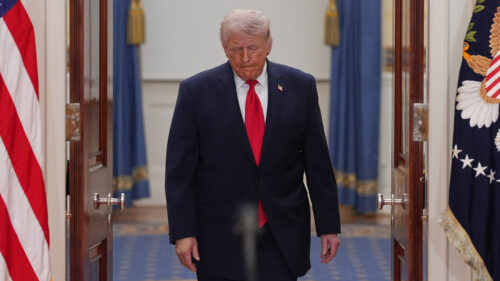
They didn’t have to wait long. Even as the G7 meeting was in session, U.S. President Donald Trump was giving mixed signals online about ongoing peace talks with Iran, which has resorted to bombing gas plants in the Middle East including Qatar’s Ras Laffan, which produces a fifth of the world’s liquefied natural gas.
“Great progress has been made,” Trump posted on Truth Social. “But, if for any reason a deal is not shortly reached, which it probably will be, and if the Hormuz Strait is not immediately ‘Open for Business,’ we will conclude our lovely ‘stay’ in Iran by blowing up and completely obliterating all of their Electric Generating Plants, Oil Wells and Kharg Island (and possibly all desalinization plants!).”
Around 20 percent of the world’s oil supply has been reduced to a trickle after Iran began firing missiles at cargo ships carrying oil through the Strait of Hormuz, driving oil as high as $116 a barrel on Monday. Beijing has begun stockpiling fossil fuels to mitigate an incoming energy crunch, putting a further squeeze on global supply.
Despite promises “to take all necessary measures,” the G7 statement was thin on actionable policies beyond a “call on all countries to refrain from imposing unjustified export restrictions on hydrocarbons and related products.”
It’s the second time this month that the G7 has issued that call, illustrating how little advanced economies can do to avoid becoming collateral damage in a war they did not begin. France, which holds the G7 presidency, said the mere fact the group was discussing joint priorities was a victory in itself — especially after G7 countries agreed to release 400 million barrels of stockpiled oil to temper soaring energy prices in early March.
“The very existence of this G7 meeting in this phase, with all stakeholders and in particular the Americans … is in itself a notable and significant fact,” a French economy ministry official told reporters on Monday evening.
Brussels warned on Friday that the longer the crisis goes on, the more likely it is that the bloc will suffer a disastrous cocktail of stagnant economic growth and high inflation, or “stagflation.” The problem for decision-makers is that they have few levers to pull after the pandemic and Russian energy crisis left many EU governments, including France and Italy, carrying heavy debt.
Even Germany, the EU’s biggest economy, is under pressure after leading research institutes accused Berlin of using an infrastructure borrowing binge to plug budgetary gaps. That’s left many EU capitals with little financial firepower to counter another energy crisis, which has driven government borrowing costs up.
“If the Iran War develops into a major regional conflict it could place an even greater burden on Germany and Europe, as heavy as we recently experienced during the Covid pandemic or at the start of the Ukraine war,” German Chancellor Friedrich Merz said in Berlin at a separate joint press conference alongside Syrian President Ahmed al-Sharaa. “The best would be that this war concludes as quickly as possible.”
Limited options
The European Commission has pledged to unveil a toolkit of measures to help curb skyrocketing energy prices, such as boosting the bloc’s carbon market reserve and developing a €30 billion decarbonization fund. Brussels will also propose cutting taxes and reducing energy charges.
But the EU executive has repeatedly ruled out putting the EU’s limits on public spending on ice unless the economy falls off a cliff, recommending that governments instead focus on helping those in need in the short term.
Europe’s economic vulnerability has also put the European Central Bank in an awkward position. Its Governing Council meets in four weeks to decide whether it should raise interest rates to avoid a repeat of 2022, when rampant inflation caught the Bank off guard. Rate hikes drag on the economy, risking a recession.
“You have to think about a wider effect on the economy, and 2026 is not 2022: We don’t have the strong pandemic reopening effects, and the labor market is softer,” the ECB’s chief economist, Philip Lane, told Irish broadcaster RTE on Monday. “We will be looking at all of these considerations: no “paralysis,” but no kind of pre-emption either.”

Europa Monitor is a seasoned News Editor with over a decade of experience in journalism. Known for his editorial expertise and commitment to accuracy, Europa Monitor leads teams to deliver high-quality news content.