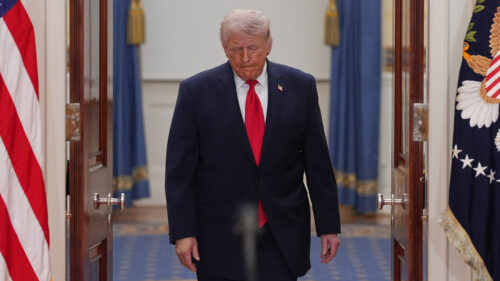
The U.S.-Israeli military campaign against Iran isn’t an endless war or an exercise in regime change, the Pentagon’s policy chief told senators on Tuesday, as the administration sought to firm up a muddled message about the spiraling, increasingly deadly conflict.
Elbridge Colby, who testified in support of the Trump administration’s new national defense strategy, is one of several senior officials trying to make the case this week that the war against Iran is targeted in its scope and doesn’t conflict with President Donald Trump’s “America First” agenda. He also contended the operation doesn’t repudiate the Pentagon’s broader new blueprint, which shifts the U.S. military emphasis to the homeland and Western Hemisphere, and urges allies to do more in their own defense.
“As we understand from [Trump] and the goals of the military campaign, this is certainly not nation building,” Colby told the Senate Armed Services Committee. “This is not going to be endless.”
Colby came under added pressure Tuesday as a member of the GOP’s more restraint-oriented wing, which has advocated lessening U.S. military commitments in Europe and the Middle East to focus on deterring China in the Pacific. He and other officials have struggled to explain how the Iran strikes, with no clear end and a shifting rationale, aren’t a repudiation of Trump’s campaign promise not to engage in “forever wars.”
“I would say America First and Peace Through Strength are served by rolling back, as the military campaign is designed to do, the threats posed by Iran’s very large and growing missile and one-way attack drone program, its navy and of course ensuring that it doesn’t have a nuclear weapon,” Colby said.
His comments reinforced a public rationale that is starting to emerge from the administration. Defense Secretary Pete Hegseth, in a Pentagon briefing on Monday, said the operation was “not Iraq. It’s not an endless war.”
Colby sought to distance the U.S. from the killing of Irans’ supreme leader, Ayatollah Ali Khamenei, as “Israeli operations,” and said America’s focus was on protecting U.S. troops in the region and degrading its missile, drone and naval capabilities. He also emphasized that Iran’s missile buildup posed a “serious threat” and presented an opportunity for Iranians to envision a new future.
Secretary of State Marco Rubio said Monday on Capitol Hill that the administration opted to attack Iran in response to an “imminent threat” that Tehran could retaliate against U.S. personnel if attacked by Israel.
Hegseth, Rubio, Joint Chiefs Chair Gen. Dan Caine and other top officials will brief all members of the Senate and House Tuesday afternoon. The administration and GOP leaders are attempting to head off high stakes votes this week to require Trump to seek congressional approval for further attacks against Iran.
Several top Democrats raked Colby and the administration for deviating from a defense strategy that’s little more than a month old and emphasizes allies taking more active roles in their own defense, including in the Middle East. Top Armed Services Democrat Sen. Jack Reed (R.I) said the Pentagon “abandoned the strategy after 39 days.”
Colby argued that the campaign is far from a departure from the Pentagon’s new strategy. The blueprint, he contended, acknowledges the threat posed by Iran and points to the success of Trump’s airstrikes against Tehran’s nuclear facilities last summer. Language urging allies to take on more responsibility for their own defense is “not a kind of straitjacket” he said.
“Obviously our Israeli allies are really leaning in,” Colby said. “But we see that from our Gulf partners right now. We see it from our other partners in Europe. So I don’t think this is an invalidation at all.”
But Democrats called it sheer hypocrisy.
“The Trump administration first says it’s going to be America First, then puts out a national defense strategy and then goes to war alongside Israel illegally, unconstitutionally,” added Sen. Elizabeth Warren (D-Mass.) “And that is now the policy of the Trump administration: say one thing in a campaign, write it down on paper, and then go do whatever the hell you want.”
Republicans also shared concerns about the administration’s strategic priorities, namely Senate Armed Services Chair Roger Wicker (R-Miss.). Wicker criticized the Pentagon’s blueprint, saying it “says little about our vital interests in the Middle East” amid the war.
“This seems out of step with repeated military actions to deal with the ongoing threat with Iran,” he said.

Europa Monitor is a seasoned News Editor with over a decade of experience in journalism. Known for his editorial expertise and commitment to accuracy, Europa Monitor leads teams to deliver high-quality news content.