LONDON — U.S. President Donald Trump’s assault on global trade is threatening Ireland’s golden age of low taxes and high spending — and Dublin has to decide which one it values more.
Ireland has ridden wave after wave of foreign investment in recent years. U.S. technology and pharma companies in particular have piled in to take advantage of its well-educated, English-speaking workforce and — crucially — one of the lowest corporate tax rates in the developed world.
But that has made its public finances — the envy of the EU after six budget surpluses in the last eight years — critically dependent on a handful of multinationals. And like every other critical dependency in today’s world, the corporate tax windfall is now coming in for more thorough scrutiny.
“The reliance on a few multinationals [to fill government coffers with corporation tax receipts] is clearly a risk,” Ireland’s central bank governor, Gabriel Makhlouf, told POLITICO in an interview. It’s now “urgent” for the government to find other sources of tax revenue if Trump’s tariff threats begin to drag on corporations’ income.
Ireland’s whole economic model has been threatened by the U.S. president’s trade agenda. Trump has imposed a 15 percent tariff on all European imports — the first time pharma has faced tariffs on medicines in decades between the two blocs. He’s also threatened a far higher 100 percent pharmaceuticals tariff, but suspended it for companies that invest in manufacturing in the U.S. and those that have agreed to cut prices to American citizens.
While giants such as Eli Lilly and Pfizer have used these loopholes to dodge the blow, the ongoing threat poses a greater risk to smaller companies that have not secured bilateral tariff-free deals with the U.S. government.
The U.S. Supreme Court’s decision on Friday to strike down Trump’s use of tariffs without congressional approval will only offer a brief reprieve, as Trump’s administration has long vowed to find other legal avenues to keep its tariff wall upright if need be.
In the short term, at least, there’s no reason to think that corporation tax receipts are going to “go into reverse,” Makhlouf said. Demand for weight-loss drugs made in Ireland, which gave a significant bump to its economic output last year, is likely to remain buoyant.
“But that is not my concern,” he argued. “My concern is the medium term. My concern is about actually committing to spending on the assumption that these receipts are just going to continue.”
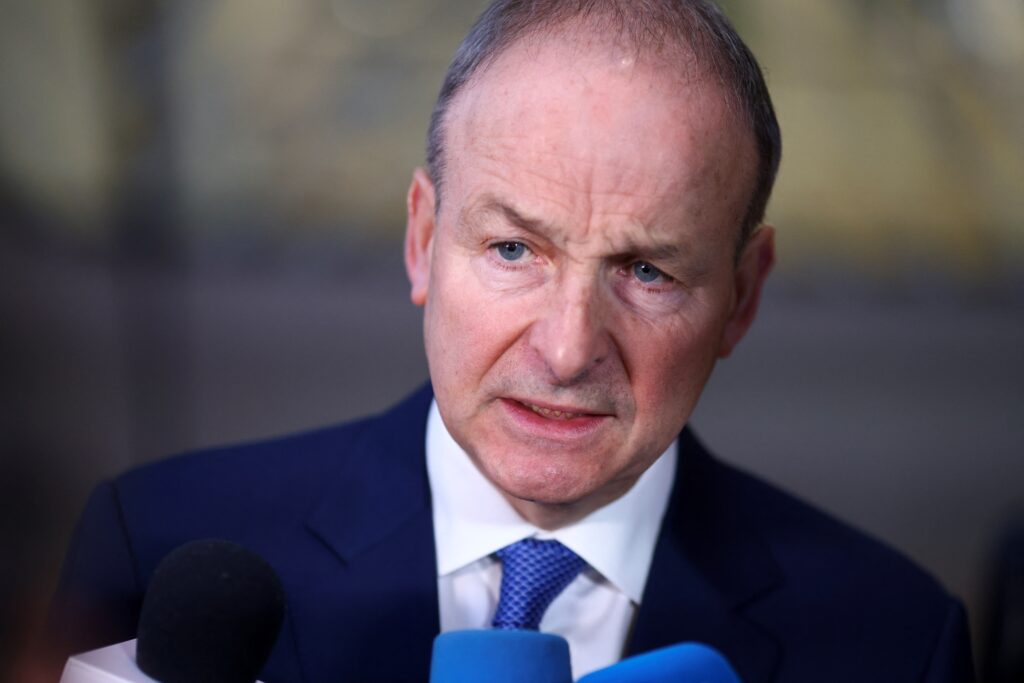
Taoiseach Micheál Martin’s coalition government has committed to raising public spending by an average of 7.4 percent a year over the coming three years. The Irish Fiscal Advisory Council says that spending will swallow 90 percent of expected corporation tax proceeds, begging the question of how those commitments will be financed if and when those proceeds do dry up.
Makhlouf said Dublin needs to broaden the tax base by implementing the recommendations of a report by Ireland’s Commission on Taxation and Welfare, set up by the previous government.
That report, which urged raising taxes on capital and wealth, eliminating VAT loopholes and a host of other surefire vote-losers, has been gathering dust for three years while the corporation tax bounty kept flowing.
The government published a 12-point action plan on accelerating the permissioning process in December, which Martin promised would provide “a comprehensive roadmap of targeted actions to tackle the core barriers to delivery of housing, energy, water, public transport and roads infrastructure.”
Housing crisis brewing?
Irrespective of corporation tax receipts, Makhlouf warned that Ireland is already bumping into constraints that will stop it growing. Above all, he said, the country needs more houses, and quickly. A lack of them in suitable places is stopping businesses from going ahead with planned expansions, he argued.
“As I travel around the country, I’m hearing people say ‘Well, actually, we want to expand here but we can’t, because we can’t get the people or they can’t commute in easily; so we’re thinking about going elsewhere.’”
It’s a far cry from 16 years ago, when the collapse of a massive property bubble forced Ireland to seek a bailout and left swathes of unsold and unfinished properties across the country. Since then, the Central Bank has been on a crusade, in Makhklouf’s words, “to prevent reckless borrowing and reckless lending.”
The origins of that crash mean that concerns about real estate lending are never far from the surface. Makhlouf said that relaxing the local capital surcharge on banks for lending, the so-called countercyclical capital buffer, isn’t the answer to the current problem, even though it’s among the highest in Europe.
He pointed to steps already taken to help first-time buyers in the housing market. “I don’t think tweaking our macroprudential rules any further would help,” he said. Instead, the country needs to fix a planning system that has either scuppered some projects completely and delayed or inflated the costs of others.
“You don’t need people to commit more money to building more things,” he said. “You need people to commit to speeding the process up, because that will get you your houses faster. In Ireland, we haven’t done that.”

Europa Monitor is a seasoned News Editor with over a decade of experience in journalism. Known for his editorial expertise and commitment to accuracy, Europa Monitor leads teams to deliver high-quality news content.