In Europe, fur is on borrowed time. On social media, it looks untouchable.
As the European Union debates whether fur farming belongs to the past, the International Fur Federation’s feed pumps out a steady scroll of household names.
Jenna Ortega, star of Netflix’s Wednesday, arrives at a premiere in an Italian-made shearling jacket retailing for $15,500. Pharrell Williams performs at the Grammys, wrapped in a long white coat. There is Rihanna and A$AP Rocky, Jennifer Lopez, Madonna, Kim Kardashian and Khloé Kardashian, Jeff Goldblum and Emilie Livingston, Georgina Rodríguez, and, before long, Kim Kardashian again.
Scroll long enough, and fur looks less like a fading industry than a comeback phenom. Polished, global and very much alive.
In Brussels, the question is whether the industry should exist at all.
The European Commission is days away from publishing its response to a citizens’ petition signed by more than 1.5 million people demanding an EU-wide ban on fur farming, the breeding of mink, foxes, raccoon dogs and chinchillas for their skin, and the trade in fur products.
A draft seen by POLITICO suggests Brussels will decline, proposing instead to make the sector try harder to improve animal conditions.
The decision has been expected since the end of March. It is still coming; delayed, in part, by objections from some member states and within the Commission itself.
What it will say, in broad terms, has been clear for some time. Clear enough that animal welfare groups are already calling it a betrayal. Clear enough that a formal complaint has been filed with the European Ombudsman, alleging the Commission’s deliberations were captured by the industry it was supposed to scrutinize.
Behind the image
For Mike Moser, the gap between the social feed and the farm is the story.
He spent years helping to manage it, first at the International Fur Federation, then as CEO of the British Fur Trade Association. Then, in 2019, he resigned and crossed to the other side. He now consults for Humane World for Animals, an organization he once debated in the British parliament.
What turned him wasn’t an argument. It was a farm visit.
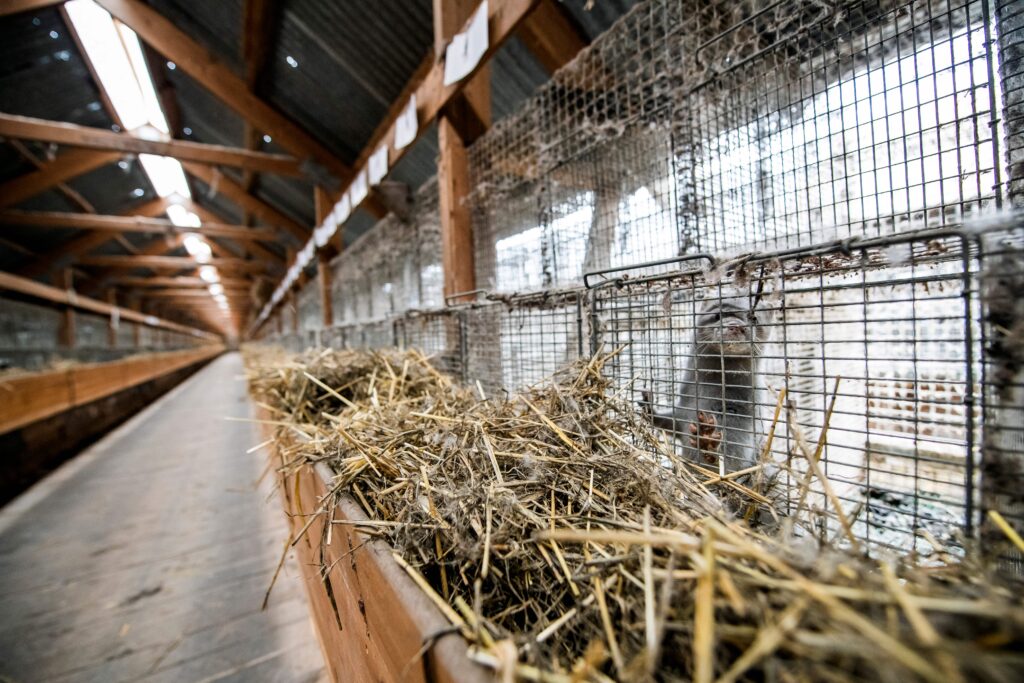
“The first time I went, I was genuinely shocked,” he said. Long sheds. Small wire cages, packed together. Animals pacing, circling, pulling back in fear or lunging forward. The smell — not farm smell, he clarified, but something sharper, the concentrated waste of thousands of carnivores dropping through mesh floors. Flies.
“These are wild animals,” he said. “Thousands of them in tiny cages.”
He had taken the job believing that better communication could fix a misunderstood industry. What he found, Moser said, was an industry that hadn’t changed — not in its practices, not in its economics, not in its basic model of keeping territorial, wide-ranging species in small enclosures at high density. At the peak of the market, around 2014, when mink pelts were fetching €200 each at auction, producers still hadn’t reinvested in welfare improvements.
“The practices haven’t changed,” he said. “They are a throwback.”
The Commission’s own scientific advisers have already delivered a verdict. A 2025 review by the European Food Safety Authority found that the welfare harms of fur farming, including stress, confinement, the inability to perform basic natural behaviors, could not be meaningfully fixed within the existing cage system. Meeting these animals’ needs, EFSA concluded, would require scrapping it entirely.
That finding sits at the center of what has become an uncomfortable question for the Commission. If their own experts say the model can’t be fixed, what exactly is a new set of welfare standards supposed to achieve?
Beyond the farms
Today, only five EU countries still allow fur farming on any meaningful scale. One of them, Poland, one of the world’s largest producers, banned it last year, giving farmers eight years to wind down.
Mark Oaten, the International Fur Federation’s CEO, was speaking from Istanbul between meetings with fur traders when he fielded the question of whether his industry was dying.
He suggested checking the auction results.
“Speak to Fendi. Speak to Louis Vuitton. Speak to Dior,” he said. “They’re all using fur, they’re all selling fur.”
Like Moser, Oaten came to the sector from outside — a former Liberal Democrat MP, headhunted after leaving Westminster in 2010 to help modernize an industry he said he barely knew existed.
What he found surprised him. Not a cottage trade but a complex global supply chain, running from farms in Finland and Greece through processing workshops in Italy, auction houses in Helsinki, manufacturers in Hong Kong, and finally to boutiques in London, Paris and Rome.
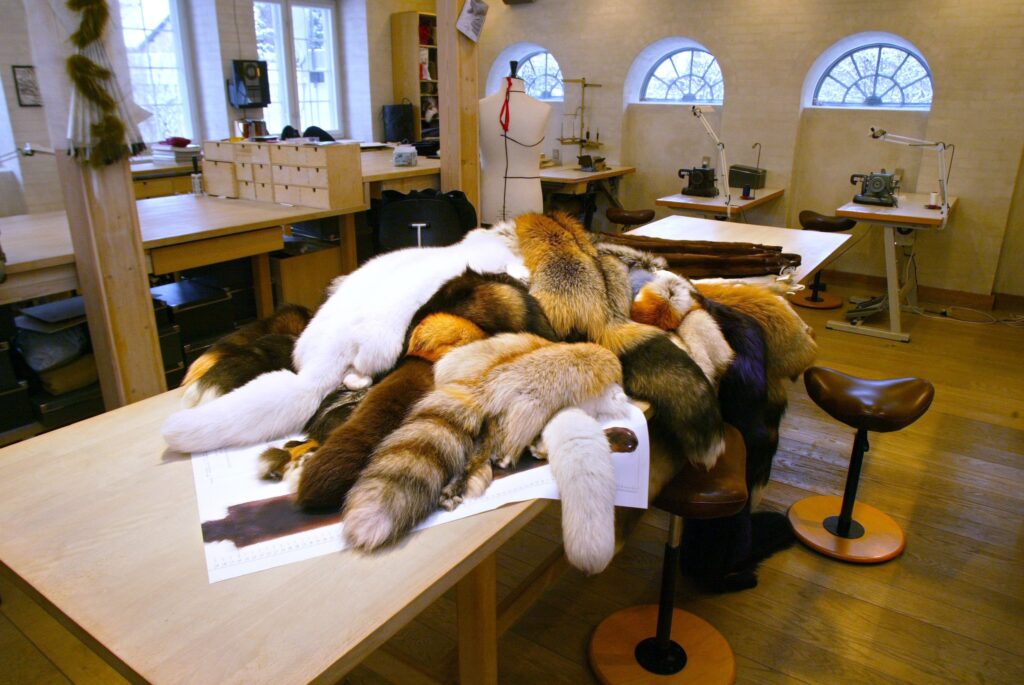
That complexity is part of his answer to the decline narrative. Saga Furs, in Helsinki, is now the only major European auction house still operating. A single skin bought there might travel through four countries before it becomes a coat. The raw export figures cited by critics, Oaten argued, miss most of the value.
The industry, he said, is artisanal by nature: a family workshop outside Verona, fourth generation, producing bespoke garments that can sell for €200,000. Not a mass-production business, not designed to employ thousands — but high value, and, in his telling, experiencing something of a revival.
Post-Covid, Oaten said, younger buyers have been drawn to vintage fur through sustainability thinking: natural materials, longevity, the antithesis of fast fashion. Sales at Saga Furs recently hit their highest level in years. The celebrity promotions are deliberate, he acknowledged without apology.
“We work with influencers. We encourage and promote the use of fur among celebrities,” Oaten said.
He kept his defense on animal welfare concerns brief. The industry, he said, already polices itself through an EU-recognized certification scheme that sets independent welfare standards, and has signaled it is prepared to accept tighter standards.
Some changes pushed by campaigners, he argued, sound humane but aren’t — replacing wire cage floors with straw, for example, leaves animals lying in their own waste. Science, not optics, should guide improvements. And the alternative to European production, he warned, was not less fur but worse fur, from Chinese farms with no equivalent standards.
“The fear is you would see an influx of product from poor quality farms.”
Brussels’ dilemma
Animal Welfare Commissioner Olivér Várhelyi oversees the file. He is known among officials as someone with a constitutional allergy to the word “ban” — on fur, on cages, on the live transport of animals.
“I’ve never heard him speak about banning anything,” said one Commission official, granted anonymity because they were not authorized to speak publicly.
Those who drafted the response inside the Commission have said, according to people familiar with the discussions, that they were never asked to draw up a ban at all. The instruction, from the outset, was to work toward standards.
Miltos Karakoulakis chairs Fur Europe, the industry’s main EU lobbying body, and runs a mink farm in the mountains of Greece’s Western Macedonia, near the Albanian border. He came away from three days of Commission workshops feeling that his message had landed.
Karakoulakis had arrived ready to challenge what he described as decades of “fake news” — images of filth and cruelty that, he insisted, belong to a different era. Modern farms use barcoded feeding systems. Animals are monitored. Welfare protocols are strict.

He was also ready with a factoid he likes to cite: that most people who sign anti-fur petitions had never set foot on a fur farm.
“So you see,” he said, “it’s not so objective.”
In his region, he added, fur farming supports around 7,000 jobs, or 60 percent of the local economy — a figure dramatically larger than the Commission’s own estimate of 2,000 jobs across the entire EU sector. Whether that discrepancy reflects different methodologies or different agendas is, at this point, a matter of whom you ask.
At a European Parliament hearing last month, the collision between those two worlds was vividly visible. Dutch lawmaker Anja Hazekamp confronted Várhelyi directly after POLITICO reported the Commission was set to reject the petition’s call for a ban.
“Apart from the fact that it’s a horrendous existence and they mostly die a horrendous death,” the Left MEP said, “it is high time that you actually took upon your shoulders the responsibility and banned this terrible industry. Otherwise you are not worthy of the title of Commissioner for Animal Welfare.”
Várhelyi was unmoved. “I don’t know why I deserve such a passionate view,” he replied, “including blaming and shaming for something that we have only started working on.”
Várhelyi did not respond to POLITICO’s request for comment. The Commission’s final response — setting out its plan for species-specific welfare standards, with draft legislation to follow by the end of 2027 — is expected in the days after Easter.
Moser, watching from Essex, had a prediction for how it would eventually be remembered.
“When future generations look back,” he said, “they’ll ask: Did we really keep animals in tiny cages and slaughter them for a product we don’t need? And the people who had the chance to act will be judged.”

Europa Monitor is a seasoned News Editor with over a decade of experience in journalism. Known for his editorial expertise and commitment to accuracy, Europa Monitor leads teams to deliver high-quality news content.