KILIFI, Kenya — Four years ago, Italy’s biggest oil company started approaching Kenyan farmers with an intriguing pitch: Plant castor seeds on your land, and we’ll promise to buy the crop and turn it into climate-friendly jet fuel.
Eni, which is part-owned by the Italian government and makes most of its money selling planet-warming fossil fuels, boasted that the Kenyan initiative would provide customers “with fully decarbonized products” while creating “models of sustainable agriculture by promoting social development.”
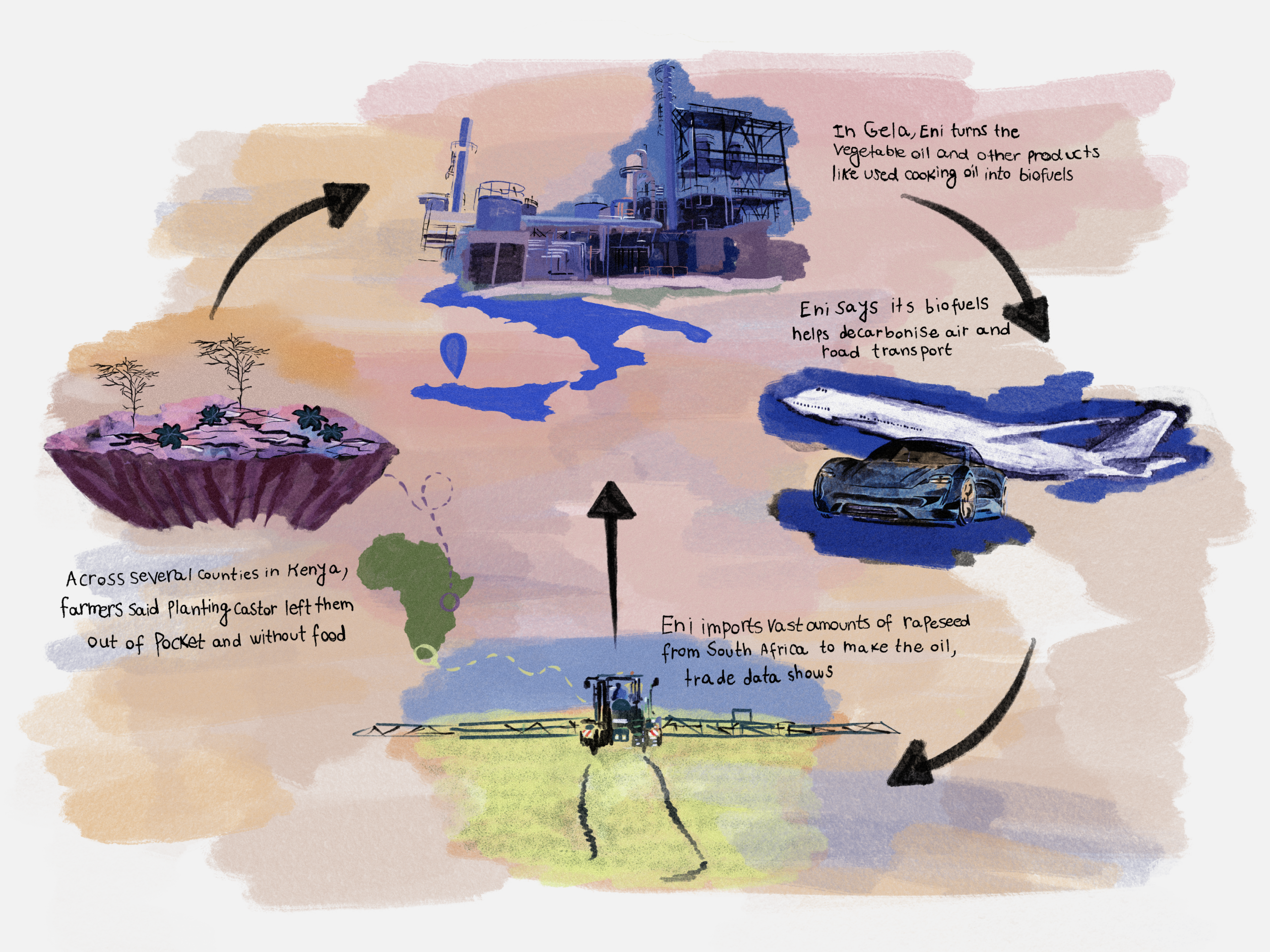
Today, Eni’s Kenyan operation is sending tens of thousands of tons of vegetable oil back to its refinery in Sicily each year to make biofuels for planes, cars and trucks.
All this is done with the backing of Prime Minister Giorgia Meloni’s government in Rome, and under the auspices of the European Union, which requires airlines to slowly replace fossil fuels with greener, bio-based alternatives.
But a joint investigation by POLITICO and the British investigative outlet SourceMaterial reveals a dark side to this project. Interviews with more than 40 farmers reveal smallholders being encouraged to grow castor beans, only to be abandoned by the middlemen that had recruited them on Eni’s behalf. Many were left with a useless, inedible crop which they had planted instead of maize.
Moreover, trade data suggests as much as 80 percent of the vegetable oil that Eni exported from Kenya to Italy last year doesn’t actually come from sustainably grown Kenyan castor seeds at all, but is made from edible vegetable oil using rapeseed imported from South Africa — which critics say appears to violate EU standards that stipulate only non-food and non-feed crops can be used for sustainable aviation fuel.
Eni says it complies with EU laws and that its Kenya programme is “designed to avoid negative impact on food production and guarantee food security for farmers” and is having a “positive impact on local communities.” The company denies that castor had replaced food production for farmers.
The investigation — which involved nearly 60 interviews with farmers, NGOs, local government officials, lawyers, academics and companies — raises serious questions about the sustainability claims made by biofuel producers like Eni, and casts doubt over the European Union’s ability to enforce its own biofuel standards.
It adds to broader concerns that the global biofuel supply chain, on which many sectors are depending to meet their climate targets, is opaque, poorly regulated, environmentally damaging and open to abuse.
The farmers
Katsele Shauri Mitsanze was one of many farmers in Kilifi County, Kenya who jumped at the opportunity to plant castor after a local company called Servizi Agricoli Forestali Africa pitched it as a wonder-crop.
If farmers switched to growing castor, SAFA would pay life-changing cash for the harvests. Eni would use the plants to make vegetable oil and turn that into green fuel for customers including BMW, easyJet and Ryanair.
Mitsanze planted castor across her smallholding, replacing the maize crops she and her seven children relied on for food. They harvested the inedible beans and waited, but SAFA never returned.
“The officers said they would come and collect them, but they never came,” said Mitsanze. “My family really suffered because of the hunger.”
Through local companies like SAFA, Eni has handed out seeds to more than a hundred thousand farmers across Kenya for a flagship project backed by the Italian government.
Eni’s Kenyan project was partly funded by the International Finance Corporation, an arm of the World Bank, that lent it $135 million, and by the Italian Climate Fund, which loaned $75 million.
The Italian government, which holds a major stake in Eni, hopes its Mattei Plan — named after Eni’s founder — will reset relations with Africa through investments aimed in part at curbing migration.
Not all the farmers involved in Eni’s project complained. Out of 42 interviews with farmers involved in the project, two farmers from Nakuru county said they were satisfied with the project.
Meanwhile, Eni has compensated for failing Kenyan harvests by shipping in vast quantities of South African rapeseed— a food crop that the EU says should only be used in minor quantities in green fuel — trade data suggests.
“This is the exact opposite of what the project is supposed to achieve,” said Carlo Tritto, sustainable fuels manager at Transport & Environment, a non-profit group that shared the data exclusively with SourceMaterial and POLITICO.
Eni had pledged to use rapeseed only in “marginal” quantities for one of its Kenya agrihubs. It acknowledged that use of edible oils for fuel production “affects the food market globally, destabilizing the availability and prices.”
Asked about this, Eni argued that using rapeseed still complies with EU environmental laws and that using the crop made sense for the project to run as planned. “It is a standard and virtuous practice to optimize the supply mix of raw materials during the execution phase,” the company said.
In its responses to POLITICO and SourceMaterial, Eni also argued that the rapeseed sourced from South Africa can be used to produce sustainable aviation fuel under EU law as it’s cultivated on “severely degraded land,” pointing to an annex under the Renewable Energy Directive.
The annex in question states that it permits: “Crops grown on severely degraded land, except food and feed crops, where used for the production of biofuel for the aviation sector.”
Eni denied that castor had replaced food production.
“The programme is built on a principle of voluntary participation, according to contractual terms and conditions agreed between aggregators and farmers,” the Eni spokesperson said. “Farmers are free to join or exit the initiative at every cycle without any penalties,” he added.
Biofuels bet
The European Union is betting big on what it calls the “bioeconomy.” In November 2025, it unveiled plans to replace fossil fuels in products like plastics, building materials, chemicals and fibers with biomass — organic materials from trees and crops.
Biofuels are also a core part of the bloc’s green transition plan. The transport sector is the biggest cause of greenhouse gas emissions in the EU, according to the European Environment Agency. Aviation in particular is one of the toughest sectors to decarbonize. Brussels has set targets requiring airports to make at least 70 percent of aviation fuel “sustainable” by 2050.
The EU’s agriculture commissioner, Christophe Hansen, called for more flexible rules to stimulate biofuels production at a global food conference earlier this month. Oil producers and car manufacturers have also lobbied for biofuels. Using them means holding onto petrol-burning engines rather than switching to electric power or alternative fuels like hydrogen.
But environmental groups have warned of the risk of greenwashing due to a lack of transparency into the origins of the raw materials, and what they describe as exaggerated claims about the environmental benefits of biofuels.
“It’s a mistake politically to bet on biofuels. The traceability standards are just not there yet,” said Pax Butchart, a campaigner at Biofuelwatch, a non-profit group. “Their ability to reduce carbon emissions is very suspect because of that.”
The EU is “working on an improvement of the system of sustainable certification,” a spokesperson for the European Commission said.
‘Selling hope’
Eni’s Kenya project aims to enroll up to 200,000 small-scale farmers and reuse “degraded land not suitable for food production.” The company says it has recruited 130,000 farmers to date. The castor beans they grow are turned into oil that is shipped to Sicily to be refined into fuel.
In 2022 Eni’s intermediaries began traveling between rural villages, drawing crowds with news of a drought-resistant crop that would thrive where maize and beans failed.
“They were selling hope,” said Cherono Kimosop, 78, a farmer from Baringo county in northwestern Kenya.
David Kemei was one of the agents tasked with winning farmers over. Hired by SAFA, Kemei went from farm to farm, eventually signing up around 200 growers for Eni’s scheme.
They expected that buyers would pay “a very high price,” said Kemei, 45. “We really thought that this would be one of the biggest cash crops in Kenya.”
But when the harvest came, only around 10 of Kemei’s recruits made a profit, he said. After making promises and handing out seeds, in many cases SAFA owner Diego Barili did not return to buy the crops, Kemei said.
Barili and his farming estate are featured in some of Eni’s brochures advertising the project.
“He was exploiting farmers,” Kemei said. “After he disappeared, a lot of the farmers were left with uncollected yields, so they had to destroy the harvest in order to prevent the cows from eating the castor and getting poisoned.”
Kanini Chanze Menza, 56, who planted castor with seeds from another intermediary in Kwale near the coast, said her family was left without food when no one came to buy the beans.
“We were depending on the harvest,” said Menza, who has 11 children. “There was a lot of hunger.”
Michael Mwena, who managed 1,500 Kwale farmers for Agricycle East Africa, another Eni intermediary, said they turned on him when they were left with unsold crops.
“I’m not ready to carry another bit of blame from such a kind of company,” he said. “They really betrayed my farmers.”
In Kilifi, near the port city of Mombasa, another agent, Bryan Mulewa, said he helped distribute seeds to 800 cultivators before the intermediary that hired him went bankrupt in 2023 after buying harvests from only 50 of them.
At his office in the Kenyan town of Naivasha, Barili declined requests for an interview and told SourceMaterial he would dismiss employees who spoke to reporters. In an email, he said that allegations his company failed to collect harvests were “fake” and that for food security he always encouraged farmers to plant castor on only 30 percent of their land.
Agricycle did not respond to a request for comment. Eni’s spokesperson said: “Contractual terms between aggregators and farmers are set by them at the beginning of the season.”
Eni had “no evidence or record” that the aggregators had changed the terms of the deals with farmers, the spokesperson added. The company had terminated contracts in “the few cases in which Eni Kenya learnt that the aggregator, notwithstanding the contractual obligation to do so, did not follow up properly the collection of seeds,” the spokesperson added.
Credibility gap
Local intermediaries like SAFA and Agricycle are responsible for checking that castor farms meet standards set by International Sustainability & Carbon Certification, the body Eni relies on to verify that its project follows EU laws. The ISCC is recognized by the EU as a legitimate voluntary certification scheme for biofuels.
Customers including the airlines that buy Eni’s biofuels also rely on ISCC ratings to make claims about the sustainability of their fuel, as does Eni’s refinery at Gela in Sicily.
ISCC’s audits have come under scrutiny after allegations of serial fraud in biofuel imports from Southeast Asia caused alarm in the EU. Earlier this month, a SourceMaterial investigation revealed that an ISCC-certified Indonesian exporter targeted in a fraud probe supplied European energy majors, including Eni.
Reliance on voluntary certification schemes “can make the system intrinsically vulnerable,” said Massimiliano Bienati, head of transport policy at the think tank ECCO, adding that with “control mechanisms depending largely on company records and the link to the original biomass becoming progressively more indirect,” there is an increased risk of fraud.
There are also doubts over corporate claims about biofuels’ green credentials. In 2024, Dutch airline KLM retracted sustainability claims about ISCC-certified fuel after a lawsuit. The same year, the European Commission launched an investigation into 20 airlines, asking them to review their biofuels claims.
The Eni spokesperson said that “some aggregators working with several farmers” had received certificates from ISCC guaranteeing a low risk of land for food crops being planted with castor.
Of the nine aggregators identified in this investigation, none has a “low risk” certificate, according to ISCC’s online records. Only one, Janari Farms, previously held a certificate, which expired in August 2025.
ISCC said in a statement that it does not comment on specific cases and that compliance “is verified through independent third-party audits.”
Food security
Eni’s Kenyan biofuels project uses “raw materials cultivated on degraded, semi-arid or abandoned land that are not in competition with the food supply chain,” according to the company’s website.
Castor is “not replacing previous food crop production,” Eni said, and safeguarding food crops is also among the conditions laid down for Eni by the International Finance Corporation, the World Bank arm that has lent $135 million to the project.
“What the standard says is that there should be no impact on food security,” said Anastasia Ngatti, environmental specialist at the IFC. “You cannot replace corn with castor.”
In interviews with farmers across Kenya, SourceMaterial heard repeated claims from farmers that planting castor instead of maize had left families without enough to eat.
Jackson Chepkaitani Changkmsony, a 66-year-old farmer from Koitumet in Baringo County, said he bought seeds because intermediaries told him they could be “intercropped” — grown among food plants in the same field.
“They enticed us by saying that they would till our land and give us the seeds, and we could also intercrop with greengrams and beans,” he said. “I had to forgo maize because we were discouraged from intercropping both. That year, the castor failed. I had no reserves of maize.”
To feed his family, Changkmsony was forced to sell goats and scrape a pittance from charcoal burning, often relying on handouts delivered through the local chief’s office, he said.
“How do you advise farmers to plant castor and not maize, which will bring food to their tables?” said Hamisi Thuva Salim, 34, the assistant chief of Mnyenzeni, in Kilifi County.
Valerio Bini, a University of Milan professor who interviewed 50 farmers in Eni’s project in May 2025, said that virtually all had replaced food crops with castor.
“Despite everything that’s said about using marginal lands, essentially 100 percent of the farmers — except for very rare cases — were growing food on those fields before planting castor,” he said. “This directly competes with food production in areas where food security is already fragile.”
Crop failure
Changkmsony is not the only farmer whose castor crop failed.
Across Kenya, Eni’s project has struggled to deliver enough castor to its Sicilian refinery — so much so that it has begun to combine the castor oil it makes in Kenya with oil from rapeseed shipped from South Africa.
According to 2025 trade data from Volza, rapeseed oil represented about 80 percent of all biofuel feedstock exports from Kenya to Italy. In the same year, Eni Kenya imported about 58 kilotons of rapeseeds from South Africa, the data shows. Eni told POLITICO that the rapeseed oil made up about 40 percent of “total exported volumes” by Eni Kenya in 2025, which refers to all exports, not just biofuel feedstock.
Rapeseed is a food crop and EU rules say that food and feed crops cannot be used in sustainable aviation fuels unless it is “offset” with other genuinely sustainable feedstocks elsewhere in a company’s supply chain — a method called the “mass balance system,” which Eni employs.
It means that Eni mixes “different batches” of feedstock into its biofuels, using a “strict bookkeeping system” to ensure the overall balance of green fuel is maintained, a company spokesperson said.
Critics say this amounts to greenwashing. “Food-crop biofuels deliver limited climate benefits, pose land-use change risks and compete with food production,” said Transport & Environment’s Tritto.
Although Eni said that rapeseed is acceptable for sustainable aviation fuel because it is “cultivated on severely degraded land,” EU rules state that such cultivation must not include “food and feed crops.”
Eni did not answer detailed questions about the company’s land use, nor did the company provide certification proving this claim when asked by POLITICO and SourceMaterial. The energy company insists its Kenya project is proceeding as planned and compliant with IFC conditions.
The IFC said in a statement that “Eni remains in compliance with both the IFC’s financing conditions and performance standards” and that it “is aware of concerns about the welfare of smallholder farmers participating in the project and is engaging with Eni to understand the situation.” The project is not “a simple trade-off between biofuel production and food crop cultivation,” it said.
‘Path to growth’
Despite farmers’ complaints, Eni, a self-described “key player in biofuel innovation,” is pressing ahead in Kenya. Its Sicilian refinery produced 40,000 tonnes of sustainable aviation fuel last year, and Eni aims to supply a third of the European market, pushing capacity to more than 2 million tonnes a year by 2030.
Even as criticism mounts, Eni has been able to count on a powerful ally: the Italian government. In October, Italy’s environment and energy minister, Gilberto Pichetto Fratin, called biofuels a “path to growth for Italy, for the transformation of refineries.”
Italian delegates helped spearhead a pledge at last year’s COP30 climate summit to quadruple sustainable fuel use by 2035, while Italy has helped push the EU to drop an outright ban on the sale of combustion engines by 2035 in favor of more flexibility for the use of biofuels. At an Italy-Africa summit in Ethiopia in February, Meloni underlined biofuels’ key role in the EU-backed Mattei Plan.
The Italian Ministry of Environment and Energy Security did not respond to multiple requests for comment.
Angelo Bonelli, an MP for Italy’s Greens and Left Alliance, told SourceMaterial that the government-run Italian Climate Fund has repeatedly refused his requests for information about its $75 million support for what he described as Eni’s “predatory” Kenyan project.
“Agricultural land is taken away — often in areas where hunger and malnutrition are everyday emergencies — to be used for biofuel crops that serve to guarantee energy for Italy rather than food for local communities,” he said.
In Baringo, farmer Pius Kipkemboi remembers how in 2022 he attended a baraza, a village meeting where SAFA’s Barili encouraged the community to embrace Eni’s biofuel crops.
A year later he cut his losses, ripping up his castor trees and replanting maize for food.
“I thought they were sincere. I thought they had done their research and that this would be a suitable place to grow castor,” he said. “They conned us.”
Costanza Gambarini and Luke Barratt reported from London and Kenya. Marianne Gros and Leonie Cater reported from Brussels. Pierra Nyaruai contributed additional reporting from Kenya and Amy Thorpe contributed reporting from London.
CORRECTION: This article has been amended with the correct spelling of Carlo Tritto.

Europa Monitor is a seasoned News Editor with over a decade of experience in journalism. Known for his editorial expertise and commitment to accuracy, Europa Monitor leads teams to deliver high-quality news content.