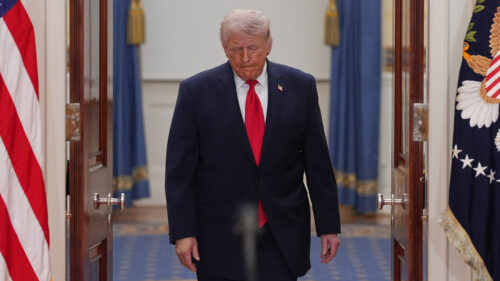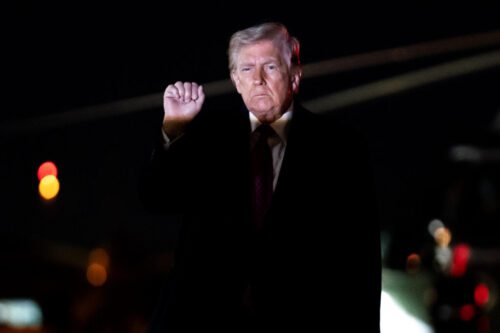
President Donald Trump on Tuesday threatened to halt trade with Spain and said he had instructed Treasury Secretary Scott Bessent to “cut off all dealings” with the country, amid a dispute over the use of jointly-operated military bases on Spanish soil.
“We’re going to cut off all trade with Spain,” Trump said during a sit-down with German Chancellor Friedrich Merz in the Oval Office. “We don’t want anything to do with Spain.”
Spain is a member of the European Union, a 27-country bloc that operates a common trade policy, so any attempt to single out Madrid would create friction with other member states, like Germany, France and Italy.
Although the Supreme Court struck down Trump’s use of an 1977 emergency law to impose tariffs at will, Trump administration officials claim it “reaffirmed” his ability to use the law to take other actions, like imposing an economic embargo against a country.
During the Oval Office event with Merz, Trump queried U.S. Trade Representative Jamieson Greer and Bessent about the possibility of imposing an embargo on Spain.
“Well, sir, I think we’re going to talk about it with you,” Greer told the president. “I know that you have strong power that the Supreme Court clarified. We know you can use it and if you need to use it to assure national and economic security, we’ll do it.”
“I agree,” Bessent quickly added. “The Supreme Court reaffirmed your ability to implement an embargo.”
The U.S. president made similar trade threats against Spain last October over Madrid’s low defense spending, but never followed through.
“Spain is a key member of NATO, fulfilling its commitments and making a significant contribution to the defense of European territory. It is also a major exporting force within the EU and a reliable trading partner for 195 countries worldwide, including the United States, with whom we maintain a long-standing and mutually beneficial trade relationship,” the Spanish government said in a statement. “If the US administration wishes to review this relationship, it must do so respecting the autonomy of private companies, international law, and bilateral agreements between the European Union and the United States.”
Speaking to reporters Tuesday, Trump also said that his administration has “instituted a 15 percent tariff on everybody,” rather than the 10 percent global duty the White House put in place under a separate trade law after the Supreme Court defeat last month. The president previously said he would raise the tariff another 5 percent, but did not follow through with a formal proclamation.
Madrid this weekend blocked the U.S. from using jointly-operated bases to attack Iran as part of the U.S.-launched war now in its fourth day. Spanish Defense Minister Margarita Robles on Monday explained that American troops stationed at Morón de la Frontera and Rota airbase must “operate within the framework of international law,” and that the military installations would be prohibited from “providing support except if it is necessary from a humanitarian perspective.”
A 1953 agreement with the U.S. gives Madrid a say over how American forces stationed on its territory are used. Robles said the bases had not participated in last Saturday’s attack on Iran and would not be used for “maintenance and support operations.”
According to flight tracking website FlightRadar24, over a dozen U.S. aircraft — among them, several Boeing KC-135 aerial refueling tankers — left the Morón and Rota bases this weekend, with seven deploying to Rammstein Airforce Base in Germany. Robles said the U.S. had “likely made those moves because they knew the aircraft could not operate” from Spain.
The move was noted by Trump allies such as Sen. Lindsey Graham (R-S.C.), who blasted Spanish Prime Minister Pedro Sánchez’s government as “an aberration” that is representative of “pathetically weak European leadership that has lost its moral way.”
During the press conference with Merz, Trump added that “Spain has been terrible” and “unfriendly.”
The president once again raised Spain’s refusal to give in to his demand that NATO members commit 5 percent of their GDP to military spending — a move that prompted Trump to suggest Spain should be “thrown out” of the alliance and threaten to hit Madrid with higher tariffs last year.
He added that the U.S. didn’t need Spain’s permission to use the bases on its soil. “We can use their bases if we want, we can just fly in and use them,” he said. “No one’s going to tell us not to use them.”
The remarks are the latest sign that Trump intends to keep wielding trade threats to pressure allies over issues unrelated to commerce, including defense commitments within NATO. And it’s a signal that he has no plans on slowing a steady drumbeat of tariff threats against specific countries, despite the Supreme Court striking down tariffs he imposed using the 1977 International Emergency Economic Powers Act.
The Trump administration does have a number of alternative authorities it could tap to impose tariffs, though they are not as flexible. They include Section 122 of the Trade Act of 1974, which the president used to slap the 10 percent tariff on countries following the court’s decision. But the measure only allows a president to impose the tariff for 150 days, at which point it would require Congressional approval.
Doug Palmer contributed to this report.

Europa Monitor is a seasoned News Editor with over a decade of experience in journalism. Known for his editorial expertise and commitment to accuracy, Europa Monitor leads teams to deliver high-quality news content.