TALLINN — Estonia is willing to help the United States secure the Strait of Hormuz but is unsure what the Trump administration actually wants its NATO allies to do, a top Estonian minister said Wednesday.
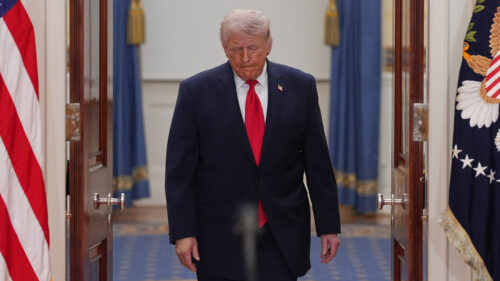
President Donald Trump appears to be on the verge of pulling his country out of NATO, citing the refusal of European countries to fully join the U.S. and Israel’s war against Iran. But even countries that are open to helping Trump are struggling to decipher what the U.S. wants from them.
On a recent visit to Washington, Defense Minister Hanno Pevkur observed that Тrump had first “said that [NATO] should do something together with them [the U.S.] together in the Middle East, then he said we don’t need the allies, and then he said that the allies should do it themselves.”
“So in just three days you have three different direction messages,” he told POLITICO on Wednesday.
Unlike some other European countries, Estonia has said it is willing to discuss how it could help reopen the Strait of Hormuz.
In mid-March, Pevkur flew to Washington where he met with senior U.S. defense officials and conveyed that Estonia was, in his words, “ready to talk.”
But since then, he said, he hasn’t received any follow-up regarding what kind of support the U.S. is seeking.
“Even today, in the morning, I had a meeting with the chief of defense and there is no clarity from the US CENTCOM or other institutions, also on the political level, on what [the United States] requests from the allies,” Pevkur said.
Under normal circumstances, he went on, allies would receive a clear request for assistance through military, diplomatic or political channels.
In his view, NATO allies would then be open at least to discussing the request, like Estonia. “But that doesn’t mean that we are jumping into the unclarity or jumping into something we don’t know what it is,” he clarified.
The defense minister strongly disputed Trump’s characterization of NATO allies as abandoning the United States in its hour of need, citing Estonia’s involvement in Afghanistan and Iraq since the turn of the century.
“Proportionally, the amount we lost in these conflicts is equal to [that suffered by the] U.S., so we’ve sacrificed as a nation, as an army, we sacrificed our people for the common goal, to have peace in the world,” he said.
Division within NATO, Pevkur warned, only benefits Moscow.
“I believe that for all the allies, at this very moment, it is important to build bridges, not to destroy the bridges. Because this is exactly what Putin wants to see, that the West is divided,” he said.
In an interview with The Telegraph published on Wednesday, Trump said he was considering withdrawing from NATO, describing the alliance as “a paper tiger” and adding that Russia’s President Vladimir Putin “knows that.”
Estonia, which borders Russia, has been ramping up its weapons stockpiles and expanding its defense infrastructure as the war in Ukraine has begun to spill over its borders.
In the past week more than a dozen stray Ukrainian drones have entered Estonian air space. Ukraine has accused Russia of deliberately jamming the drones to redirect them toward the Baltics.
So far, the Estonian defense minister said, the war in Iran has caused “small delays” in the delivery of Israel-made weapons, while a “significant amount of U.S. ammunition,” including HIMARS artillery systems, is still on track to be delivered.
“I hope that we can trust the words of President Trump that this war in Iran will be over in a few weeks,” he concluded.

Europa Monitor is a seasoned News Editor with over a decade of experience in journalism. Known for his editorial expertise and commitment to accuracy, Europa Monitor leads teams to deliver high-quality news content.