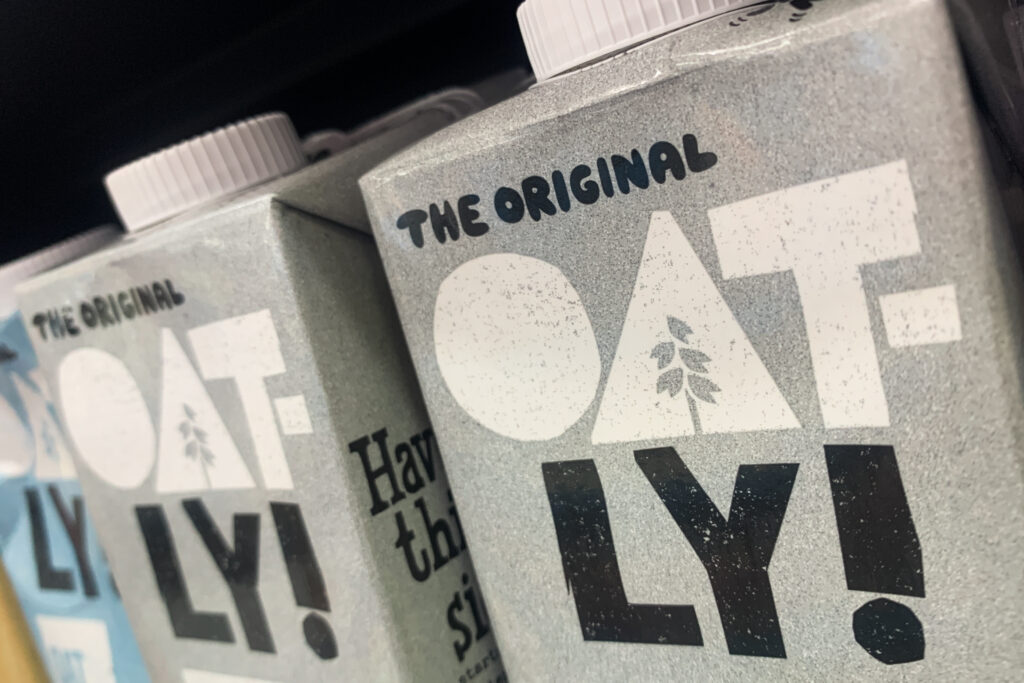
Banning vegetarian meat knock-offs from using names like “steak” and “chicken” isn’t likely to kill the alternative proteins sector, if the supermarket ubiquity of Oatly and Alpro is any guide.
Years before the debate over banning meat-free “steaks” and veggie “burgers,” the EU barred plant-based drinks and spreads from carrying labels such as “milk” and “yogurt.” Yet those rules ultimately failed to make a dent in the flourishing market for vegan dairy alternatives.
“Despite the regulation, we still managed to grow,” said Guillaume Millet, vice president for plant-based business at Danone, which owns the Alpro line of soy milk and coconut yogurt (even if you won’t see those terms on the label).
That outcome offers a reassuring playbook for the meat-alternative sector, still reeling from EU legislators last week agreeing to ban vegetarian products from using terms typically associated with meat, including “chicken,” “ribs,” “bacon,” “tenderloin,” “liver” and “steak.” (Veggie “burgers” and vegan “sausages” were spared.)
The French MEP behind the terminology ban, Céline Imart, said the outcome “protects farmers’ products … against a form of unfair competition.”
But the EU’s track record on dairy labeling restrictions suggests the competition is far from over.
After the Court of Justice of the EU banned dairy-style substitutes marketing themselves as “milk,” “butter,” “cheese,” “cream” or “yogurt” in 2017, brands like Oatly and Alpro not only continued to thrive but helped drive a broader boom in plant‑based milks across Europe.
Today, the plant‑based milk market in the EU is expanding rapidly. Annual sales were around €4 billion in 2025 and are expected to more than double by 2035 to almost €10 billion, according to one market analysis. It’s evidence that the naming rules have done little to slow consumer demand for almond-milk cappuccinos or oat matcha lattes.
Plant-based meat alternatives have seen a similar trajectory.
According to market research conducted before the EU meat term ban came into play, the plant-based “meat” market stood at around €2.6 billion in 2025. It’s projected to surpass plant-based milk earnings to roughly €14 billion in a decade, reflecting even stronger customer demands for veggie burgers and meat-free sausages.
“I think that the plant-based meat category will still manage to grow despite this nonsense regulation,” said Millet, who is also president of the Plant-Based Foods Europe trade association. The products plant-based startups are developing “will find their audience,” he added.
Taking a bite out growth
Nonetheless, the new rules will do some real damage, companies said — sowing confusion, adding bureaucracy and driving up costs while undermining innovation and sustainability.
Lost sales, rebranding, and packaging changes could cost producers around €250 million for Germany alone, according to Claudia Hauschild, deputy chair of German alternative protein association BALpro.
Millet predicted that the ban would stunt growth by about two years, and that regulatory instability would scare some companies away from the plant-based market. “You need to have a Ph.D to understand” the complex new rules, he quipped.
According to Giulia Benini from Valsoia, an Italian producer of plant-based products, it’s unclear whether companies will still be allowed to use terms like “chicken‑flavored” now that “chicken” is banned.
If not, “we would need to redesign the main part of our packaging … and it would become very, very difficult to inform consumers on what they are buying,” Benini said.
Questions like these, along with whether the rules will apply to mixed-composition products and how they will work across different languages, were set to be addressed in the technical talks by EU officials to clarify the provisional text.
The veggie product naming war has reached a provisional compromise as the EU’s scientific advisers warn achieving carbon neutrality by 2050 will require cutting harmful farm subsidies and encouraging citizens to eat less meat.
Yet changing consumer sentiment could prove a bigger threat to the sector than labels: A recent EIT Food Consumer Observatory study shows found that the share of Europeans following sustainable eating habits is falling, from 76 percent in 2021 to 69 percent in 2025.
“We believe that the focus should shift from limiting the sector to allowing fair competition and supporting innovation,” Benini said. “We offer food for people who cannot or do not want to buy the traditional food. So our goal is not to steal consumer or market share, but to give a plant-based alternative.”

Europa Monitor is a seasoned News Editor with over a decade of experience in journalism. Known for his editorial expertise and commitment to accuracy, Europa Monitor leads teams to deliver high-quality news content.