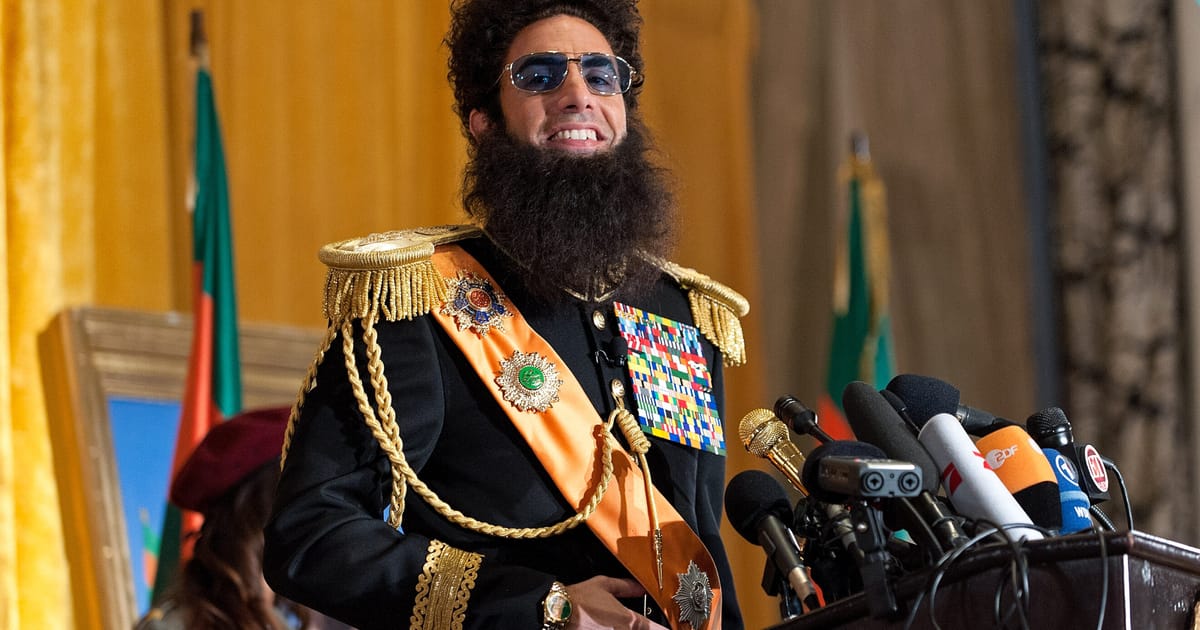
In a formal reprimand published internally on June 18 and seen by POLITICO, the Bank’s election committee sanctioned a candidate running for the staff committee, Jan Kuchta, over a campaign email sent to all ECB staff in which he styled himself as “Admiral General Jan Aladeen Kuchta” and appeared in AI-generated military uniforms adorned with European symbols.
The election committee, made up of seven randomly drawn members representing different levels of seniority among employees, concluded that while election campaigns may use “parody, sarcasm and irony,” Kuchta’s effort had crossed the line in his apparent attempts to mimic Sacha Baron Cohen’s character “Aladeen” in the 2012 movie The Dictator.
By using a parody name, militaristic imagery, hyperbolic language and mixing “plausible statements together with visibly exaggerated or even impossible campaign claims,” the campaign exceeded “the degree of rhetorical exaggeration compatible” with ECB ethical standards, the committee found.
Kuchta, who is an IT development specialist at the central bank, promised in his manifesto to replace social dialogue with “Mandatory Proletarian Solidarity Sessions,” to ensure he won with “100 percent of the vote,” and to introduce “Corrective Wellbeing Audits” for staff whose thinking had not yet aligned with official doctrine.
Beneath the central bank’s attempts to define the maximum permissible amount of irony lies a more serious dispute.
The move appears to be partly in response to new election rules introduced by the ECB in December 2025, requiring campaign material to comply with the institution’s ethics framework. In the consultation during the run-up to these rule changes, the staff committee sharply criticized these requirements as risking freedom of expression and resulting in unhealthy censorship.

Europa Monitor is a seasoned News Editor with over a decade of experience in journalism. Known for his editorial expertise and commitment to accuracy, Europa Monitor leads teams to deliver high-quality news content.