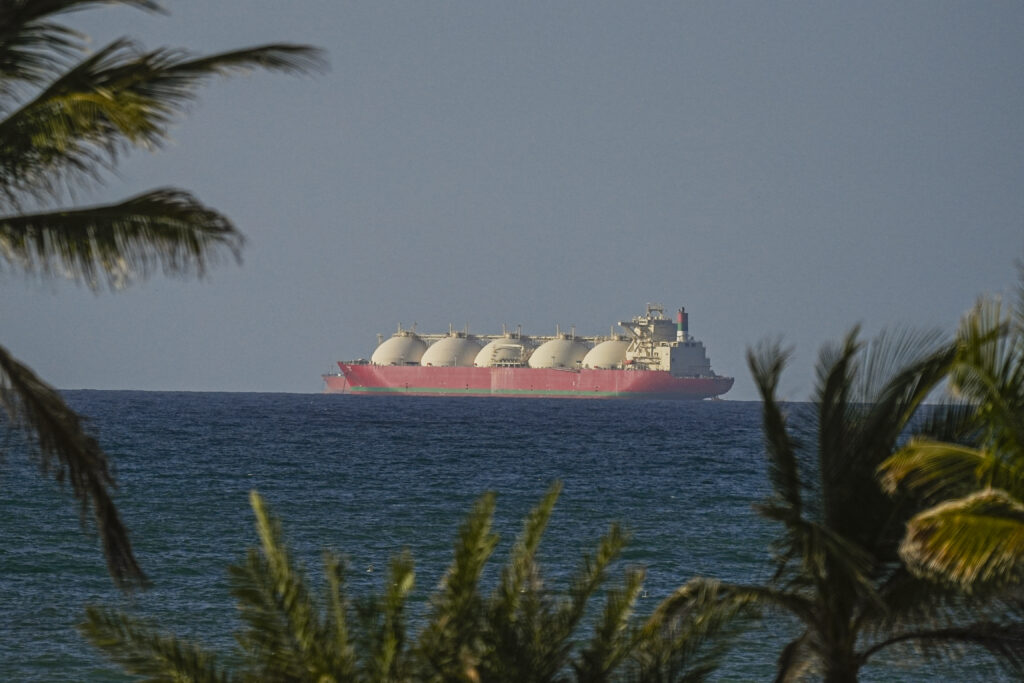
Donald Trump warned the U.S. Navy would “begin the process of BLOCKADING any and all Ships trying to enter, or leave, the Strait of Hormuz,” but actually doing so is governed by centuries-old rules of naval warfare.
While the U.S. president’s statement on Sunday called for a halt to all traffic — raising worries of a clash with other powers like China with vessels in the area — the U.S. Navy is imposing a more limited blockade that appears to conform to maritime warfare law.
At its core, a blockade is an act of war against another country which stops commercial traffic in and out of targeted ports. However, the U.S. is not legally at war with Iran — a distinction Trump has been careful to underline to avoid having to involve the U.S. Congress.
A blockade acts like “a line that is being drawn and shipping is told not to cross the line either from the inside or from the outside,” said Wolff Heintschel von Heinegg, a professor of international law at European University Viadrina in Frankfurt and a specialist in maritime blockade law.
“No ship is allowed in, no ship is allowed out, irrespective of their nationality,” said Phillip Drew, a maritime blockade law specialist and former legal adviser to the Canadian navy, now at Queen’s University in Kingston, Canada.
If ships do violate the blockade, it does not mean they can be sunk — unless they resist interception and as a last resort, von Heinegg said. But they can be stopped. That means “the ship may be captured, and the blockading power will exercise control over it.”
The U.S. action comes after weekend peace talks with Iran failed — with the reopening of the Strait of Hormuz reportedly being a key area of disagreement.
Tehran closed the strait to almost all shipping in response to attacks by the U.S. and Israel by laying mines and demanding that ships wanting to pass would have to pay a toll, something that is illegal under international maritime law. As a result, hundreds of vessels are stranded in the Gulf.
Despite Trump’s statement, which also called on the U.S. Navy to “seek and interdict every vessel in International Waters that has paid a toll to Iran,” the actual U.S. action is much narrower.
U.S. Central Command made that clear in its announcement: “The blockade will be enforced impartially against vessels of all nations entering or departing Iranian ports and coastal areas.”
That distinction was evident on Tuesday morning, when a Chinese-owned tanker, the Rich Starry, transited through the Strait of Hormuz after departing the United Arab Emirates and was not intercepted.
China, a big importer of crude oil from the Gulf, has condemned the U.S. blockade as “dangerous and irresponsible.”
U.S. Central Command said late Wednesday that no ships had made it past its blockade of vessels heading to or from Iranian ports since Monday, adding 10 vessels had been turned around.
The U.S. is aiming to ramp up pressure on the Iranian government, which refuses to accede to Trump’s conditions for ending the war. However, the operation does carry risks, as interdicting ships could inflame tensions with other countries and also exposes U.S. Navy ships to possible counterattack by Iran.
Three criteria
For the blockade to hold up legally, the U.S. must meet three legal tests.
First, a blockade has to be announced — which the U.S. has done.
States and mariners must be told where the blockade applies and when it starts. Centcom said notices were issued and broadcast on Channel 16, the international maritime radio frequency monitored 24/7 for distress and safety calls, giving ships time to leave before enforcement began Monday.
Second, it has to be effective. “You can’t just say you’re blockading and then not dedicate any forces to it,” Drew added.
Von Heinegg explained that “effectiveness means that the blockading power is in a position to, in fact, prevent vessels from crossing the line.” That does not require catching every ship, he added, but there must be a real probability that vessels attempting to breach the blockade will be intercepted.
More than a dozen U.S. warships are in the area, including vessels carrying Marine units trained to conduct boarding operations.
Third, a blockade has to be applied equally.
“It has to be done without discrimination,” said Andrew Clapham, a professor of international law at the Graduate Institute in Geneva. “As long as they stop every ship and they don’t say, for example, ‘If you’re from China, you can go through, but others can’t.’”
Even those rules have gray areas.
Although the U.S. Navy said it is only interdicting ships sailing from Iranian ports, there could be grounds to detain vessels paying the Iranian tariff, said James Kraska, a professor of international maritime law at the U.S. Naval War College and visiting professor at Harvard Law School.
Maritime law does not allow countries to charge fees for ships passing through straits used for international navigation.
Such payments to Iran could also be seen as providing a “war-sustaining benefit” to the regime, which means ships could be intercepted under the separate rules of “visit and search,” even if they are not technically breaching the blockade, Kraska said.
This article has been updated.

Europa Monitor is a seasoned News Editor with over a decade of experience in journalism. Known for his editorial expertise and commitment to accuracy, Europa Monitor leads teams to deliver high-quality news content.